



Artificial intelligence can now generate code in a matter of seconds that would previously have kept a programmer behind a keyboard for hours. But faster does not necessarily mean better, let alone safer. That is why the VUB researches and advises on how AI can be used responsibly for software development. At the same time, the university is adapting its degree programmes to a future in which developers will work alongside AI. According to VUB researchers Coen De Roover and Wolfgang De Meuter, developers are far from becoming obsolete. “Our students learn to structure code and work in teams on large projects, which are precisely the areas where AI struggles.”
The VUB is closely involved in the Flemish Cybersecurity Plan. What is your role in that programme?
Coen De Roover, professor at the Software Languages Lab (SOFT) at the VUB: “The aim is to support strategic fundamental research in the field of cybersecurity and to bring the results of that research to companies. We focus mainly on application security: the security of the software itself. For example, we carry out security testing by analysing existing software with tools that attempt to identify potential vulnerabilities. In addition, we try to promote the principle of security by design as much as possible: making software more secure from the moment it is designed. This can be achieved, for example, by designing and using programming languages and development methods in such a way that certain security risks are avoided.”
“Alongside that research, there is also an implementation component through which we transfer knowledge to Flemish industry. For example, we organise industry days with demonstrations and workshops, and the VUB annually hosts the international Summer School on Security Testing and Verification.”

Coen De Roover
Nowadays, it is impossible to talk about cybersecurity without mentioning the role of AI. Is that something you are working on as well?
Coen: “Of course, it features prominently in CODEGUARD, a VLAIO project through which we help software companies use generative AI in a responsible manner. Not only for generating code, but throughout the entire software development process. AI can, for example, be used to automatically screen developers’ contributions for weaknesses.”
AI models are improving at an extraordinary pace. Does that not make such checks redundant?
Coen: “The models have indeed become much better. But you cannot simply accept the code they propose without question. You need to critically analyse whether it does what you expect, whether it does anything else, and whether the software will remain maintainable in the long term. A piece of code may perfectly do what you asked for today, but what if you want to add new functionality next year? If you generate and implement code quickly without paying sufficient attention to quality, you will eventually pay the price for that later on. We call this technical debt. In our research, we measured the technical debt resulting from contributions made by AI agents to open-source software. Our message to Flemish companies is therefore clear: do not neglect software quality. Productivity is only one part of the story. To guarantee quality, you need good tools and processes, and you need to train developers.”
You also regularly talk about ‘cognitive debt’. What do you mean by that?
Coen: “A software development team no longer consists solely of human developers. AI agents also make contributions, and that is perfectly fine. But the more you delegate to those agents, the greater the risk that the team itself loses oversight. People then no longer know exactly how the architecture of their software is put together or where important components have been implemented. We call that cognitive debt. For throwaway software, that does not necessarily have to be a major problem. With AI, you can quickly create a simple application that you only need once. But as soon as you want to modify, expand or maintain that software later on, someone has to understand the code. Unfortunately, that is something people often lose sight of.”
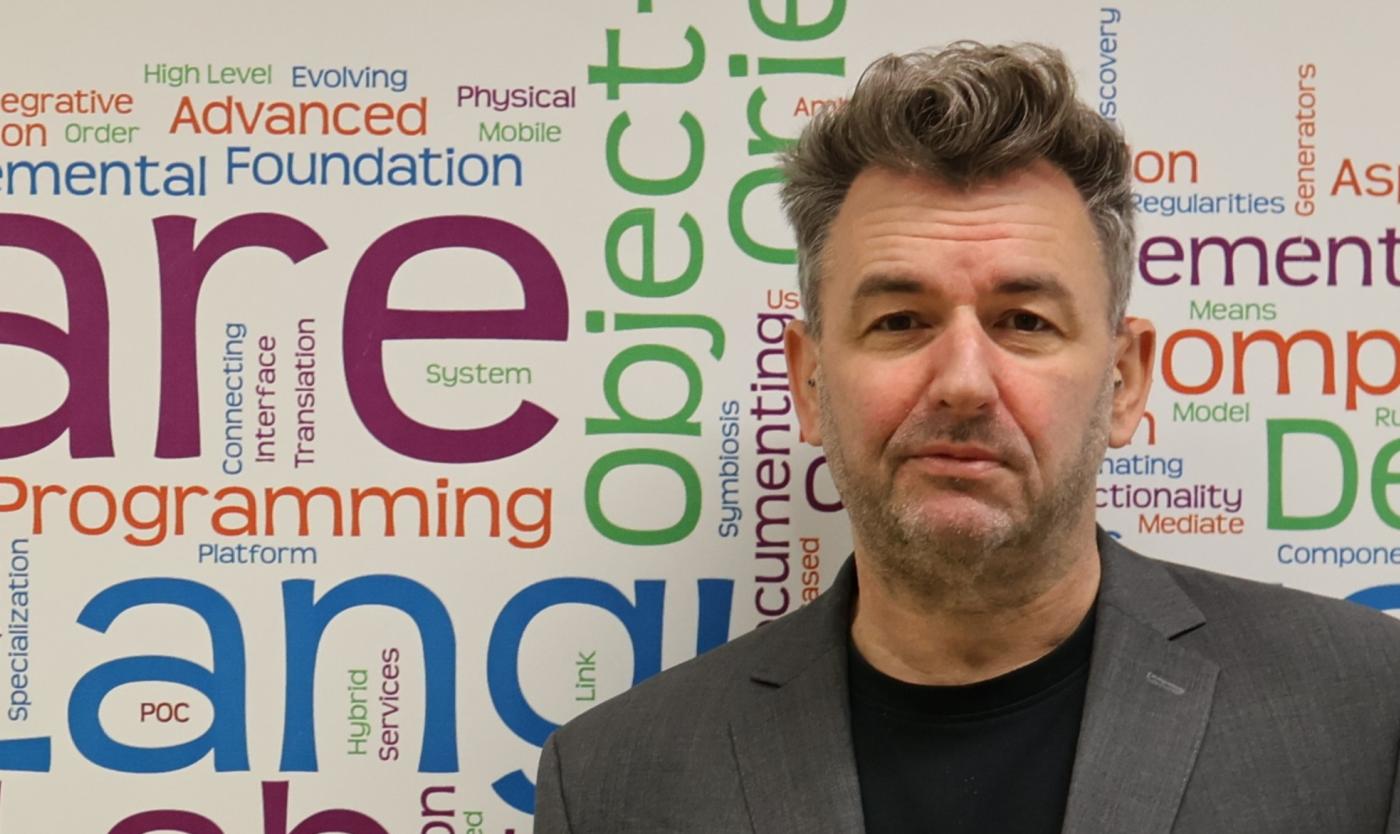
Wolfgang De Meuter
Wolfgang De Meuter, Head of the Department of Computer Science at the VUB and also affiliated with the Software Languages Lab (SOFT): “The focus when using AI today is very much on functionality: does the generated software do what I asked it to do? But other quality attributes are at least as important. In the area of security in particular, this can create major risks if such a rapidly built application is, for example, connected to a database containing sensitive information. This is therefore one of the points at which AI research and security research intersect.”
There is also the question of what happens to company information and code when it is sent to commercial AI models.
Wolfgang: “That is a massive issue. All your innovations, all your know-how: in principle, the producers of those tools have access to it all. They naturally say that they handle it discreetly, but who is going to, or even can, verify that? Intellectual property is a very important concern. As a result, we are seeing growing interest among companies in AI models that they can host themselves, models that can run on their own hardware. We are also seeing a shift towards multiple, smaller and more specialised AI models. Rather than sending every request to one standard model, it is often better to determine first which specialised model is best suited to the task. That can be much cheaper.”
So the cost of AI will also become a factor?
Wolfgang: “Absolutely. In professional use, people are charged on the basis of the tokens they use. Everything you send to a model costs tokens, but so does everything the model sends back. That can include a great deal of rubbish that is of no use to you whatsoever, yet you still have to pay for it. Ask an AI tool, for example, to write an alternative to Tax-on-Web by tomorrow and you will get something. It will not work because such a task is simply mission impossible, but an AI tool will never tell you that because that generates no revenue. As a result, a great many tokens are wasted. Companies really need to reflect on how they use AI. The idea that the use of AI is virtually free is simply not true. Some firms already understand this; in some places, programmers’ salaries are partially linked to the number of tokens they have saved.”
“Writing code yourself will probably become less important, while other aspects will become increasingly important.”
If AI keeps getting better at programming, will we still need programmers
Wolfgang: “You have to distinguish between a programmer and a software developer or software engineer. Today, AI can perform simple programming tasks extremely well. Writing a small function, creating a simple web page or connecting a database to an application: you can safely leave that sort of micro-task to AI. But software development is something different. In our university programme, students learn programming from the very first year, but at the same time they learn how to deal with the scalability and complexity of large software projects. They learn how to structure code and later how to work in teams on major projects. It is precisely with that scale and complexity that AI struggles.”
Does that also change what your computer science students are taught
Wolfgang: “The content of the job will evolve. Writing code yourself will probably become less important, but other aspects will become more important: understanding what a system is supposed to do, analysing requirements, designing a good architecture, taking future users into account, security and testing.
That is why our degree programmes must evolve as well. We must not only teach students how to program, but prepare them for a world in which AI becomes an important instrument in software development. The essence remains that they must be able to understand and control the complexity of software.”
“You will also continue to need people who direct AI agents, build the environment around them and bring the different components together. The best proof of that? Even at Anthropic, the producer of Claude, currently the most popular AI tool among programmers, they have hundreds of vacancies. Take a close look at them and what do you see? They are mainly looking for, indeed, software engineers.”
Bio
Coen De Roover is a professor at the Software Languages Lab (SOFT) at the VUB and is affiliated with the Department of Computer Science. His research focuses on programme analysis and its application to software quality, including software testing, application security, vulnerability detection and software supply chains.
Wolfgang De Meuter is also a professor at the Software Languages Lab (SOFT) and the Department of Computer Science, of which he is also Head of Department. His expertise includes programming language design.